
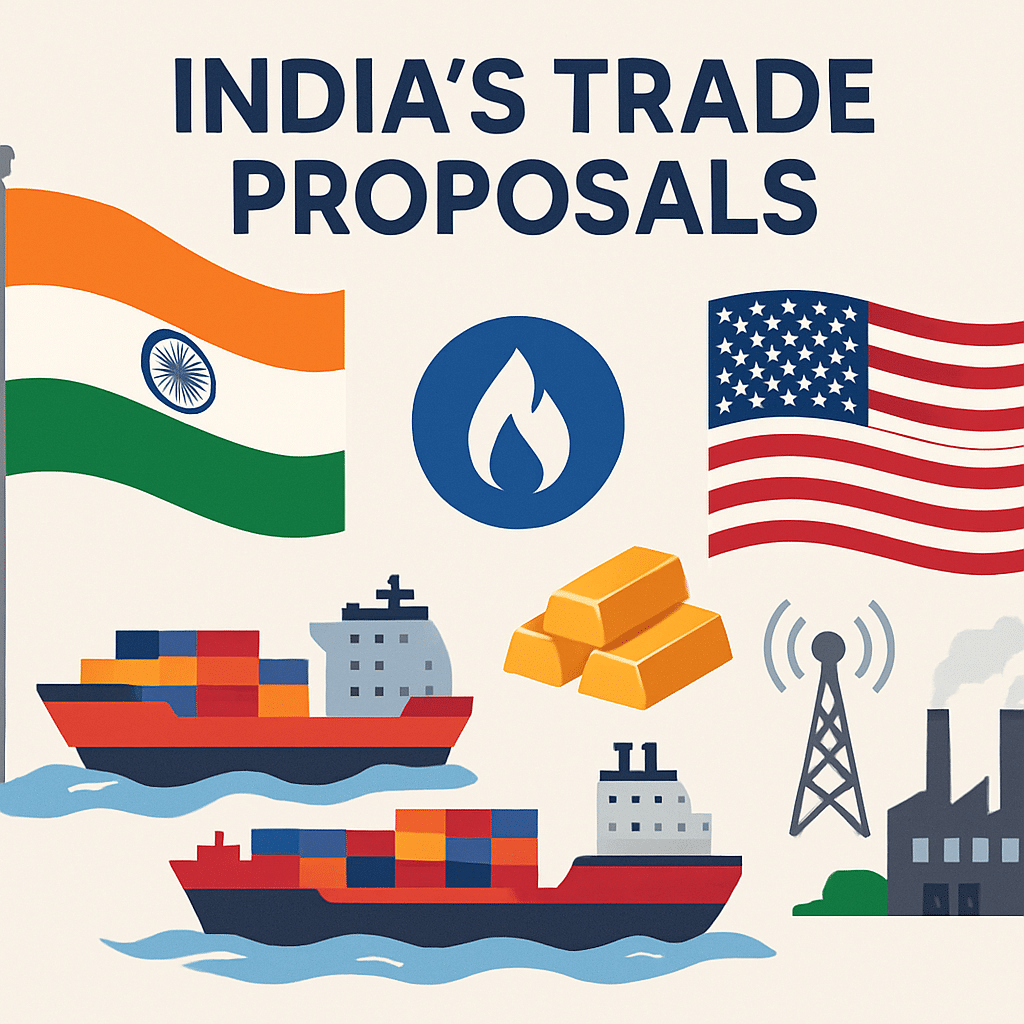

India and the US continue to negotiate trade deals, with new proposals on the table.
Table of Contents
Introduction
As global trade tensions rise, India faces critical choices in balancing its economic ambitions with changing international dynamics. Recent discussions have revealed three major proposals that New Delhi could consider to ease trade friction—especially with the US. But with uncertainty surrounding US policy and a shifting geopolitical landscape, what should India’s strategy be? This post explores the three main options India has: engaging directly with the US, expanding deals with alternate partners, and strengthening its domestic economy.
Option 1: Proposing New Deals to the US
1.1. The Proposals on the Table
India is reportedly considering three key proposals to address the current impasse with Washington:
- Increasing Imports of US Natural Gas: This could help reduce America’s trade deficit with India.
- Buying More US Communication Equipment: Expanding tech imports to support digital growth.
- Stepping Up Gold Purchases: India, being one of the largest consumers of gold, could increase official imports from the US.
All these steps could help ease tensions, but only if the US shows willingness to compromise. There is always a chance, given the leadership style of Donald Trump, that new demands may suddenly arise, making negotiations more complex.
The Challenge
“As of today, this is less likely to succeed unless the US meets India halfway.”
At present, India’s engagement with the US remains a waiting game. Success will depend on Washington’s flexibility as much as New Delhi’s.Negotiations between major economies can reshape trade policies worldwide.
Option 2: Securing New Trade Partners
2.1. Looking Beyond America
While the spotlight is on the US, India is actively cultivating relationships with other trade partners. Current talks include:
- European Union: New Delhi is deep in negotiations with Brussels.
- New Zealand, Chile, Oman, Qatar: Bilateral talks are ongoing.
- Existing Deals: With 13 active free trade agreements, India has robust trade connections.
Faced with US uncertainty, India may accelerate negotiations elsewhere to diversify its trading portfolio and reduce over-reliance on any single partner.
Option 3: Leveraging India’s Domestic Economy
3.1. Building Resilience from Within
India’s third—and potentially most powerful—option is to focus inward and build a resilient, self-sufficient economy.
Promoting Domestic Manufacturing
India’s Production Linked Incentive (PLI) scheme, launched in 2020 for smartphone manufacturing, is a prime example. In just five years, it has:
- Reduced smartphone production costs
- Helped manufacturers absorb tariff shocks
- Supported global competitiveness
However, PLI incentives were granted for only five years. With the end of these benefits, companies like Samsung are already seeing a decline in exports from India. Policymakers could consider extending incentives to ensure continued growth and job creation.
PLI scheme boosted India’s smartphone manufacturing sector between 2020-2025.
3.2. Stimulating Domestic Demand
Following China’s playbook, extending domestic stimulus could help Indian manufacturers:
- Redirect export-destined goods to the home market
- Boost internal consumption through targeted subsidies
When China faced shrinking export demand, subsidies for consumers helped soften trade shocks. While not a cure-all, similar measures could help shield India’s economy from external turbulence.
Conclusion
Every global crisis creates an opportunity to reset. India now stands at a crossroads:
- It can try to negotiate a compromise with the US,
- Strengthen alliances with alternate partners, or
- Invest in domestic industry and resilience.
Playing its cards right, India can leverage this moment to shape a more secure, robust, and dynamic economic future.


